

By: Ezra Kucur, Daniel O’Connor, and Ian Rock-Jones
Introduction
Experimental archaeology has been instrumental in deepening our understanding of Paleolithic food-ways and technologies, for example; fire control for cooking. While hearth-remains provide material evidence of fire use, experimental methods allow researchers to recreate fire-starting techniques, cooking practices, and heat management using only the materials available to early humans (“Challenges of the Past,” 2015; Cornelius 2020). These reconstructions help determine the skill level, time investment, and cognitive demands required for consistent fire use. Additionally, experiments shed light on how fire altered food properties, improving digestibility and nutritional value—insights that cannot be directly obtained from the fossil record. By replicating these behaviors, archaeologists gain a clearer picture of the trial-and-error learning processes, adaptability, and technological expertise of Paleolithic humans, offering a dynamic perspective on early human ingenuity that static artifacts alone cannot provide (see origin uncertainty/incomplete records from static artifacts described in Ambrose et al. 2001).
The process of cheesemaking provides a hands-on opportunity to explore the chemical and biological transformations involved in food science. In this lab, we employed both traditional and modern techniques to produce a variety of cheeses, including paneer, mozzarella, ricotta, mysost, and slow cultured cheese. While each group followed a foundational procedure—warming milk, adding an acidifying agent, and separating curds from whey—variations in ingredients, temperature, and post-curdling processes led to a diverse range of textures, flavors, and consistencies. The lab aimed to illustrate how small adjustments in methodology can significantly affect the outcome of cheese production, deepening our understanding of how cooking and food production may have been for early humans.
Methods
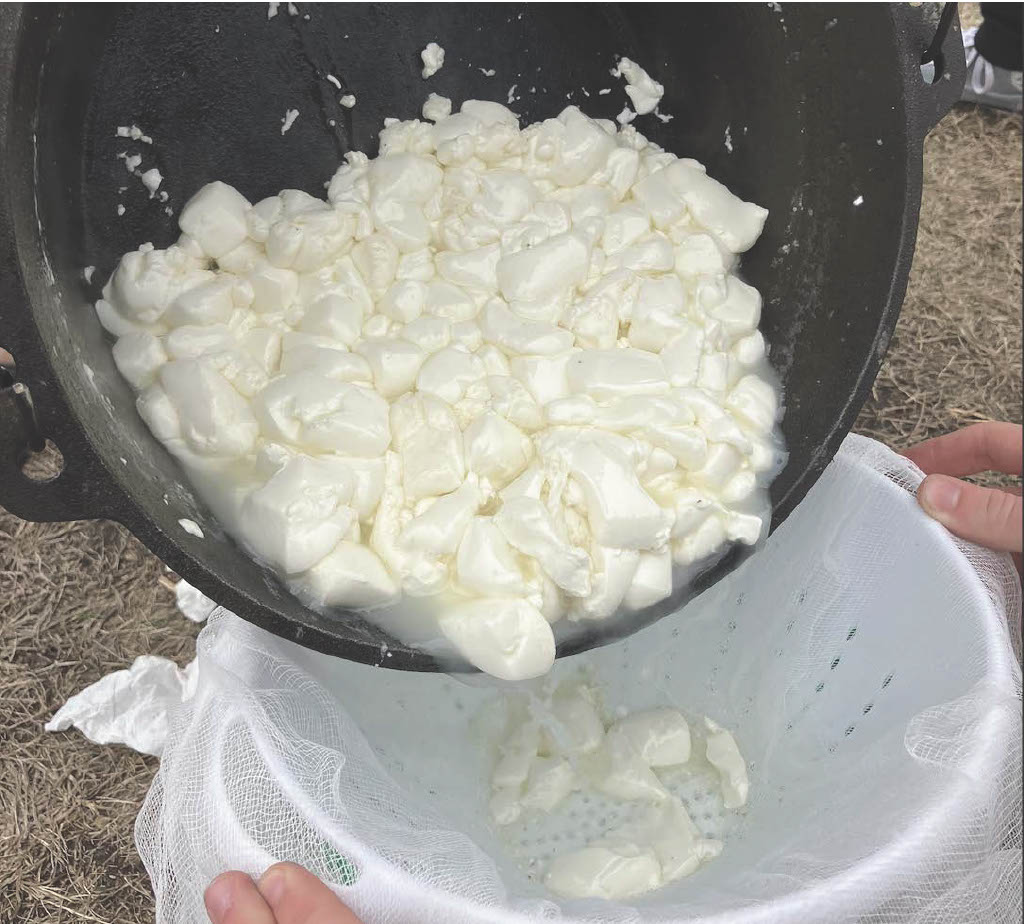
Amongst the various lab groups, several types of cheese were made, but the general process was similar throughout. Milk was warmed to 33 C, acid (lemon juice) and rennet were added, and then the milk was left to curdle until the curds on top broke cleanly. Then the curds were stirred for some time and formed into a cheese mold. Secondary processes had a wide array of procedures. These along with variations in primary processes are as follows.
Throughout these processes, fires were used to heat milk in cast iron pots, and thermometers were used to keep them at relatively constant temperatures. Cheesecloth was used in pitching curds. By working with open fires, cast iron pots, and natural acidifiers such as lemon juice and kefir, the lab also provided a glimpse into the kinds of materials and conditions early cheesemakers might have used. This experiential approach allowed students to better understand the ingenuity required to manipulate perishable resources and preserve food without modern technology. Through this, the lab aimed to illustrate both the scientific and historical dimensions of cheesemaking.


| Cheese type | Slow-Cultured | Paneer | Mozzarella (primary) | Mozzarella (secondary) | Ricotta | Mysost |
| Group(s) | A | B | C, D, E, F | C and F | A and E | D |
| Method | To make a slow cultured cheese, in place of the lemon juice, kefir was added to the milk. This was done after the rennet, once the milk was already warmed, and the milk was left to culture for an hour afterward. | Paneer was made without adding rennet, and the acid only once the milk was not just warmed, but brought to a boil. Then the milk was drained and the leftover paneer was pitched. This group also experimented with frying and salting, to great effect. | The process for the initial mozzarella was very similar to the standard process described above, but the acid was added before the milk was warmed. | The secondary process mozzarella was made by taking the primary mozzarella, cutting it into pieces, and reheating those pieces in 65 C water. Then these pieces were taken out and kneaded, before being resubmerged, and eventually brined. | The groups making ricotta combined their whey with milk, which was warmed to isolate the solids that didn’t go into the original cheese. These solids were then skimmed of the top of the milk, pitched, and pressed into a cheese form. When milk was not available, cream was used instead. | To make mysost, whey was heavily reduced over a boil, cream was added, and then the mixture was further reduced to a goop which was cooled and then formed. |
Data and Analysis
A key aspect of experimental archaeology is the meticulous documentation of each step in the process, this includes observations– like notes on how the color changes– or data points like temperature, volume, etc. These practices are important because they ensure the experiment is not only reproducible, but also to make sure the results can be a meaningful comparative to anyone conducting similar experiments.
Qualitative Observations
Data collectors from each group were tasked with collecting density (g/L) measurements from the following: milk, curds, whey, whey cheese, and whey cheese byproduct whey, along with recording both liquid and fire temperatures.
For many of us, it was the first time we had to maintain a constant pot temperature for over 30 minutes, while using an open fire. To this end, most groups struggled to keep the pot contents at the optimal 32ºC needed for curd formation– with the exception of Group B, whose method required the milk to boil (100ºC) for their paneer making.
Here are 4 visuals depicting the heat measurements from 4 groups throughout their processes:
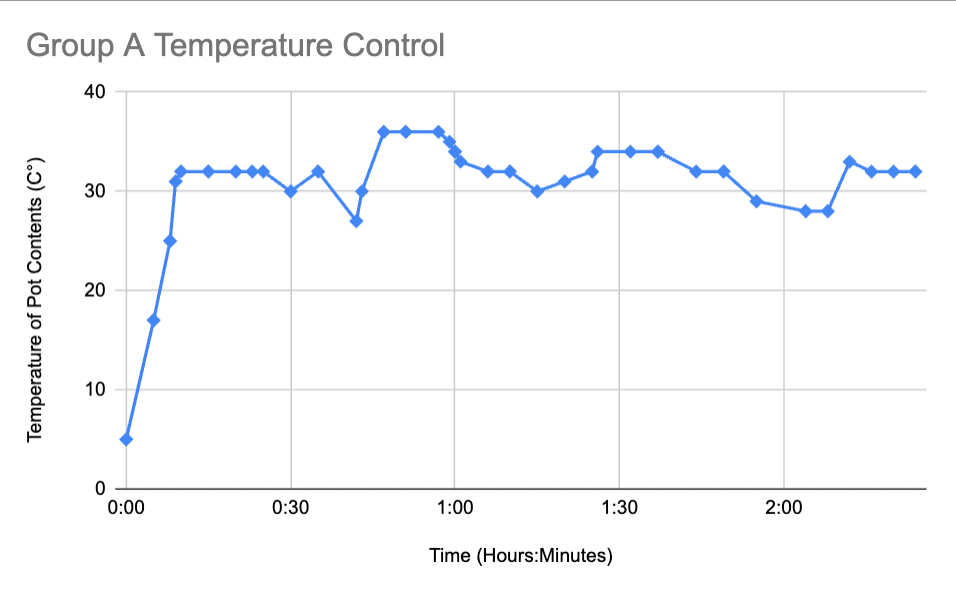
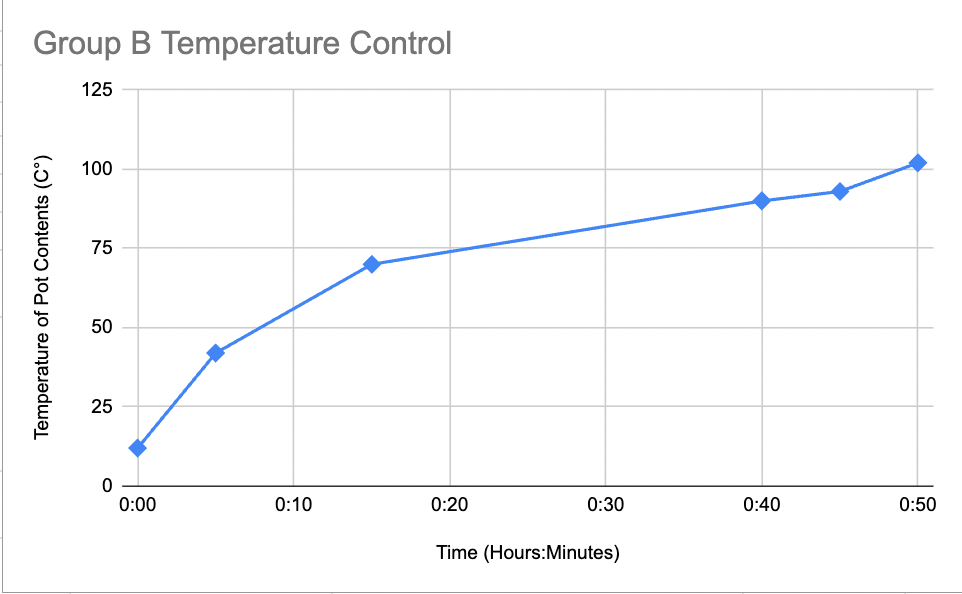
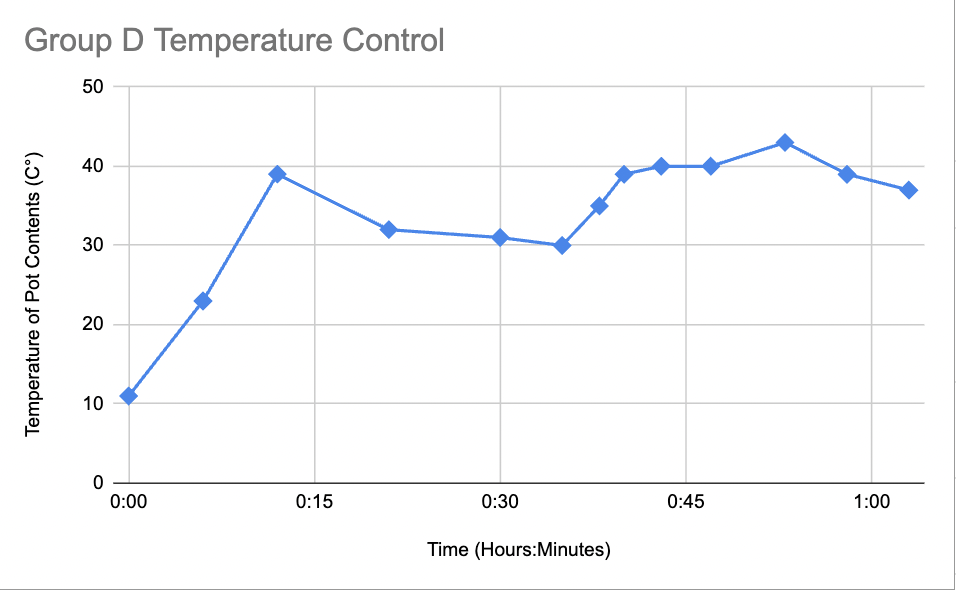

From these graphs, it’s clear how often the temperature of the pot contents fluctuated– often above the desired 32ºC. Maintaining a constant 32ºC is evidently difficult, but also essential, as changes in the cook temperature may affect the moisture content of the curds, leading to structural changes of the eventual cheese (Lamichhane, Kelly, and Sheehan 2018).
Another pertinent measure when it comes to cheesemaking, is the percentage of the original milk product that has been transformed into usable curd– this is known as yield efficiency. To calculate the yield efficiency, we’ll take the total mass of the curds, then divide that by the starting mass of the milk.
Here we’ve broken down the yield efficiency and byproduct spread, using Group F’s data:


This chart shows what percentage of the 3910 grams of milk was turned into different byproducts (~16.6% to cheese, ~83.4% into whey). The percentage discrepancies are noted, as the total weight of all the curd and whey exceeds that of the starting milk. However, this likely linked to the addition of 2 1⁄2 cups of acid-water, which was part of Group F’s culturing process.

Having a yield efficiency of around 17.1% tells us that around ⅙th of Group F’s milk ended up as cheese. Although this seems like a low yield, the leftover whey can now be used as a starter for some cheeses, like Group D’s Mysost. Extracting all the nourishment possible was crucial in a prehistoric/ traditional setting, as resources like milk were harder to come by, and carried more value. This is why the reuse of a byproduct, like whey, is great because it increases the milk’s overall yield efficiency.
Conclusions
This lab demonstrated the versatility and complexity of cheesemaking through the exploration of multiple techniques and cheese varieties, while also serving as a window into early human food processing and preservation. Despite beginning with a shared foundation of milk, the differences in acidifiers, the use of rennet, heating procedures, and secondary treatments such as brining or frying yielded distinctly different final products. The experiment highlighted the importance of precise temperature control and the role of both chemical and enzymatic processes in curd formation and cheese texture. Moreover, by using tools and techniques that reflect pre-industrial conditions—such as open-fire heating and natural fermenting agents—we experienced some of the physical and logistical challenges early humans would have faced. These included maintaining consistent heat, relying on natural microbial cultures, and improvising with available materials. Ultimately, the lab reinforced key concepts in food chemistry and microbiology while also emphasizing the adaptability, experimentation, and resourcefulness that early cheesemakers would have needed to transform milk into a stable, nourishing food.


0 thoughts on “Lab Summary Week 2: Cheesemaking”