

Madeleine Goldberger, Natalie Tatar, Caleb Valentino
INTRODUCTION
This week our class studied ancient Greek rituals. Specifically, we looked at ancient ritual fires. In ancient Greece, ritual fires were essential to religious life and served as a direct connection to God and was a symbol of unity.
In order to prepare for the lab, we read excerpts from The Odyssey and The Iliad, as well as articles written by archaeologists, including Professor Morton. Additionally, we analyzed different vase paintings from the ancient world that have been collected and displayed in various museums. Throughout the week we discussed the different ways that these rituals were painted onto these vases and attempted to recreate these images in real life in our lab on Thursday. There were six different lab groups, each with slightly different set ups and materials, that carried out the lab.
The lab was split up into two main parts. The first was the recreation of ritual fires, which included, building the fire, burning the specific materials given (for example beef femur and oxtail), as well as the splanchna (consisting of heart, liver, and kidney). Once this part of the lab was finished across all groups, everyone moved on to part two. In the second part of the lab, all lab groups made small ash altars in attempts to recreate the more than 20-foot tall historic Olympian ash altar. These experimental models were made up of different types of ash as well as different kinds of liquid to cement and hold the models together.
PART 1: RITUAL
METHODS
The first part of the lab began with each group gathering the necessary materials. All groups needed tools for building and maintaining the fire, including firewood, firewood, firestarter, tongs, and oven mitts. A box of matches, a tarp to block the wind, and thermometers were shared among all 6 groups. Each group also got a beef femur, a set of splanchna, and a stick for roasting the splanchna. Groups 2 and 5 were also given a kind of fat known as omentum, Group 3 was given 4 sheep tongues, and Groups 1, 3, and 6 also burned ox tails.
Groups then began weighing the thigh bones. This included measuring circumference of various areas, length, and weight. See Fig. 1 below for these measurements, which will be discussed further in the results section. As of April 29, 2026, Group 1 has not posted a Lab Group Data report. As such, their results are missing from all data.
Weight (g) | Length (cm) | Circumference of Middle (cm) | Circumference of End (cm) | Extra Measurements (g) | |
Group 2 | 2313 | 46 | 23 | 36 | Omentum: 450 |
Group 3 | 291 | 43 | 9 | 45 | Tongues: 422 |
Group 4 | 1719 | 41 | 12 | 55 | Tail: 1401 |
Group 5 | 2614 | 44 | 12 | 47 | Omentum: 475 |
Group 6 | 2350 | 36 | Not measured | Not measured | Tail: 1750 |

Next each group built their fire according to images seen on vase paintings: a flat topped wood pile with layers of wood arranged perpendicular to each other. Most groups reported using two or three layers and placing the fire starter on top. Many also remarked on the stability of the wood pile. It was challenging to get the fires started due to the high wind, so groups used a tarp to block the wind and often invoked the assistance of Jake or Parker.

Once the fires had been built, groups were ready to begin the rites at the altar. Groups with omentum wrapped the fat around their bone, then all groups added their thigh bones to their fires. Groups 1, 4, and 6 also placed their tails on the fire at this time. Each group measured the progress of the burning femur differently. Group 2, one of the groups with omentum, noted the times when the fire flared up the highest. Groups 3, 4, 5, and 6 made more general physical observations about the burning process as a whole. Both groups with tails, 4 and 6, took note of how curled the tail was at various times.

Group 3 then also began to cook their tongues. They added each of the four tongues at a slightly different time and allowed two of the tongues to burn completely while only cooking the other two until they were edible. Group 3 also recorded data on how much people enjoyed the taste of the tongues, and were surprised to find that people enjoyed them quite a bit (especially with hot sauce).
Next, each group began to spear their splanchna. Some groups reported cutting the organs while other groups attempted to cook them whole. Similarly to the burning of the femur and tail, not all groups recorded equal data. Groups 3, 4, and 6 all took detailed measurements of the temperature of various organs at different times. All groups agreed that it was challenging to cook the splanchna to the correct temperature, but attributed their struggles to a myriad of diverse factors. Finally, various groups tried their splanchna. Overall there were mixed reviews.

Finally, groups put out their fires by pouring wine on them. Many groups commented on the sweet smell that arose from this. Group 5 also noted that this caused their femur to fracture and turn almost blue. The charred femurs and tails were then removed from fires and remeasured. See these new measurements in Fig. 3, and again see the results section for a more in depth analysis.

The next day in class we looked at all the bones to see if we could determine which had been wrapped in omentum and which had not. Groups attempted to pay close attention to the specific shades of black, grey, and white of the charred bones, as well as specific shiny or bubbly textures. Ultimately everyone agreed that while we could potentially observe some differences, they would be impossible to recognize on an excavated bone.
RESULTS
Since each lab group conducted slightly different experiments, they all got slightly different results. Each group was able to have successful fires and successfully burn all materials that they were given.
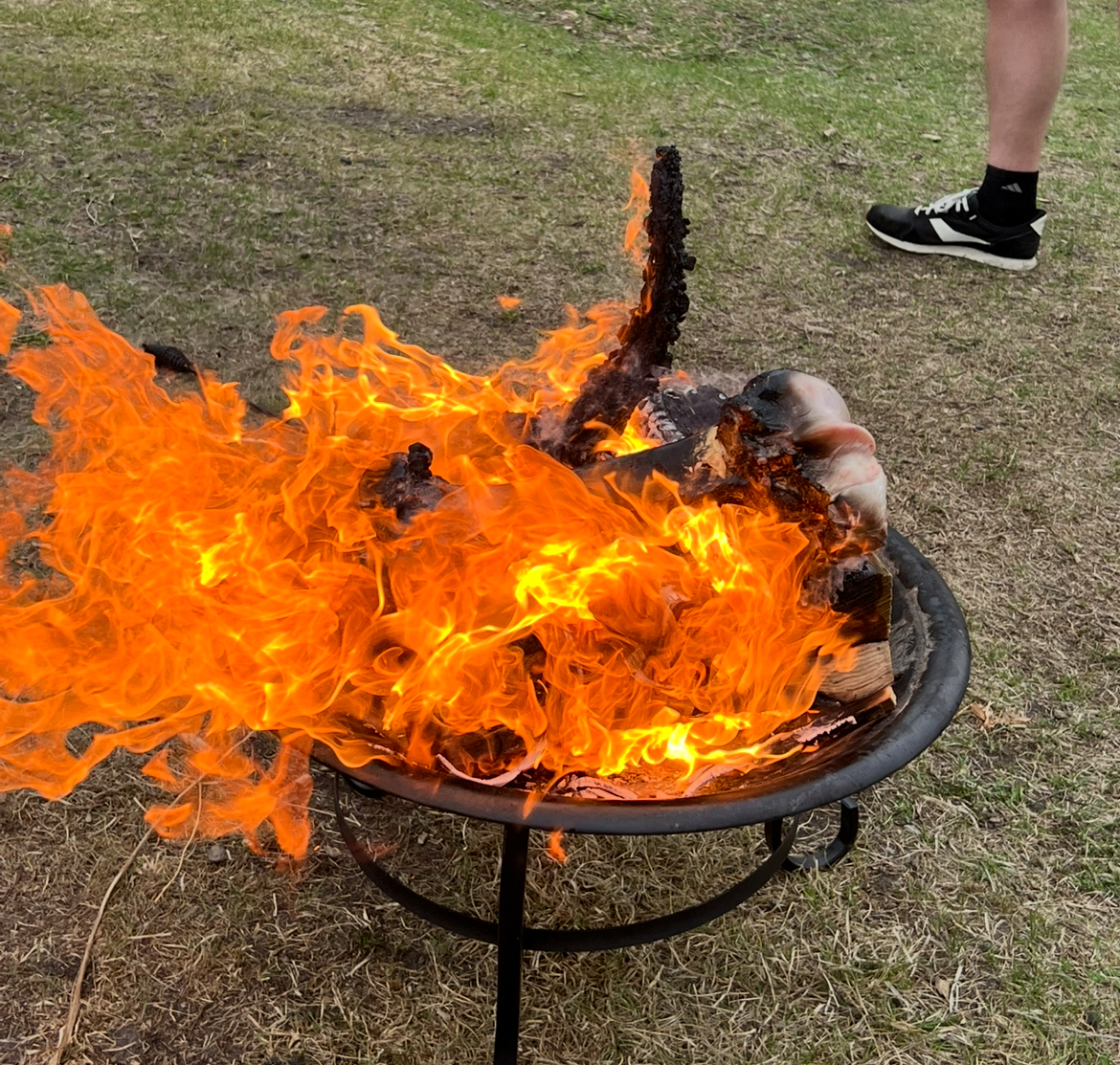
For example, Group 4 burned both a beef femur and an oxtail. One of the main goals of the lab was to successfully see the oxtail curl, like it had been depicted on the vase paintings which we had discussed in class prior. As shown below, the tail was able to curl, and did so in a “beautiful” way as Professor Morton stated.
| Curl Angle (degrees) | Group 4 Time (minutes) | Group 6 Time (minutes) |
| 0 | 0 | 0 |
| 90 | 10 | 21 |
| 180 (collapse) | 28 | 34 |
The table above demonstrates the amount of degrees the tail curled and the time it took for both Group 4’s and Group 6’s lab. Group 4’s tail was able to curl in 28 minutes compared to Group 6’s time of 34 minutes. Since each group had a different fire pit set up, this may have influenced the speed of which the tail curled. Once the tail curl angle reached 180 degrees, it collapsed and was unable to curl any further.
As demonstrated in the table in the methods section, all groups weighed the materials that they were burning in the ritual fires before and after they were placed in the fire. As Fig. 3 demonstrates (and as hypothesized) each item once burned decreased in mass. Also, the weight before and after burning is depicted in the below table. For example, Group 2 burned both the beef femur and Omentum and it went from 2763 grams to 1222 grams.
| Weight Before Burning (grams) | Weight After Burning (grams) | |
| Group 2 (Omentum and femur combined) | 2763 | 1222 |
| Group 3 (Femur) | 2911 | 1109 |
| Group 4 (Tail and femur combined) | 3102 | 1157 |
| Group 5 (Omentum and femur combined) | 3089 | 900 |
| Group 6 (Tail and femur combined) | 4100 | 1242 |
Fig. 3
| Femur Condition | Group 2 Time (minutes) | Group 3 Time (minutes) | Group 5 Time (minutes) | Group 6 Time (minutes) |
| Bone marrow flow | 7 | |||
| Full black (charred) | 25 | 17 | 15 | |
| Break | 20 | 29 | 23 | 28 |
In Fig. 4, Groups 2, 3, 5, and 6, recorded the time and condition of the beef femurs being burned. For example, for Group 5, it took 7 minutes for bone marrow to flow out of the beef femur, 17 minutes for it to become black and charred, and 23 minutes for the bone to break. Group 3’s beef femur took the longest amount of time to break (29 minutes) compared to Group 2’s which took the shortest amount of time at only 20 minutes. Once the beef femurs were broken the bones were removed from the fire and studied in class the next day.
Additionally, most groups were able to cook their splanchna to a hot enough temperature for it to be safe to eat. Some students tried the heart while others tried the kidneys and livers, and some abstained from tasting it at all. Many of the students who did try parts of the splanchna thought it “tasted a lot like chicken” and was “very hard to chew.” Fig. 5 demonstrates Groups 2, 3, 4, and 6, and the amount of time to cook the splanchna. Group 4 at the shortest amount of time (9 minutes) and Group 6 at the longest (19 minutes).
| Group | Time to cook splanchna (minutes) |
| 2 | 16 |
| 3 | 13(heart), 19(liver and kidney) |
| 4 | 9 |
| 6 | 19 |
Overall, all groups had somewhat successful results in some capacity. Once the fires went out, the beef femurs were extracted from the ashes (some still whole, some broken) and were taken to class to be analyzed the next day. The experiment offered a hands-on look into what ritual fires were like in ancient Greece and the powerful and spiritual nature behind them.
PART 2: ASH ALTARS
METHODS
Once the first portion of the lab was cleaned up, we jumped straight into the second portion of the lab. Each group grabbed a bowl for mixing ingredients and some measuring cups, and then immediately got to work experimenting with different combinations of bone ash, indoor fireplace ash, outdoor fireplace ash (which had been rained on), fire pit ash (from the fires we had just put out), water, and wine. These clay-like mixtures were then used to make miniature altars. See Fig. 6 below for a list of all combinations tried across all 5 groups and see the results section for more discussion.
| Group.Altar | Ingredients (cups) | Description / Observations |
| 2.1 | 2 3/4 bone ash 1 water | Gelatinous Jiggly |
| 2.2 | 1 bone ash 1 indoor fireplace ash 5/8 water | Similar to clay Firmer than 2.1 |
| 2.3 | 5/4 bone ash 5/4 indoor fireplace ash 1/4 water 1/2 wine | Crumbly Firm |
| 2.4 | 7/4 bone ash 9/16 wine | Moist Firm |
| 2.5 | Unspecified mix of bone ash, indoor fireplace ash, water, and wine | Crumbly Firm |
| 3.1 | 1 bone ash 1/2 indoor fireplace ash 1/2 water 1/8 wine | Similar to paper pulp Started to crack at 10 minutes |
| 3.2 | 1 3/4 bone ash 2 indoor fireplace ash 1 water 1/4 wine | Runny Flattened after a few minutes |
| 3.3 | 1 1/2 bone ash 1/2 outdoor fireplace ash 1/2 water 1/8 wine | Similar to 3.1 |
| 3.4 | 1 1/4 bone ash 1/2 fire pit ash 3/4 water 1/8 wine | Thicker than 3.2 and 3.3 Similar to cement Cracked while being mixed |
| 3.5 | 2 bone ash 1 wine | Burned altar in fire pit Color darkened significantly |
| 4.1 | 1/2 bone ash 1 indoor fireplace ash 1/3 fire pit ash 3/4 wine | Flat Springy Dried quickly |
| 4.2 | 2 1/4 bone ash 1 1/2 outdoor fireplace ash 5/16 water 1/2 wine | Tall Able to support sticks Unable to dry |
| 4.3 | 1 fire pit ash 7/8 bone ash 2/3 wine | Medium tall Held shape Similar to slime |
| 5.1 | 1 bone ash 1 outdoor fireplace ash 1/2 water | Squishy but still firm |
| 5.2 | 1 bone ash 2 outdoor fireplace ash 1/2 water | Not as durable as 5.3 |
| 5.3 | 1 bone ash 2 outdoor fireplace ash 1/2 water Bone shards | Strongest |
| 5.4 | 2 outdoor fireplace ash 1/4 bone ash 1/2 water | Squishy but still firm |
| 5.5 | 2 bone ash 2/3 wine | Strong Crumbly when dry |
| 6.1 | 5/8 bone ash 3/4 fire pit ash 1/2 water 1/4 wine | Too aqueous Challenging to form |
| 6.2 | 2 1/4 bone ash 2 1/4 outdoor fireplace ash 1 1/4 wine | Too aqueous Challenging to form Better than 6.1 |
| 6.3 | 1 1/16 bone ash 1 outdoor fireplace ash 3/4 water | Similar to cookie dough Tall Better than 6.1 and 6.2 |


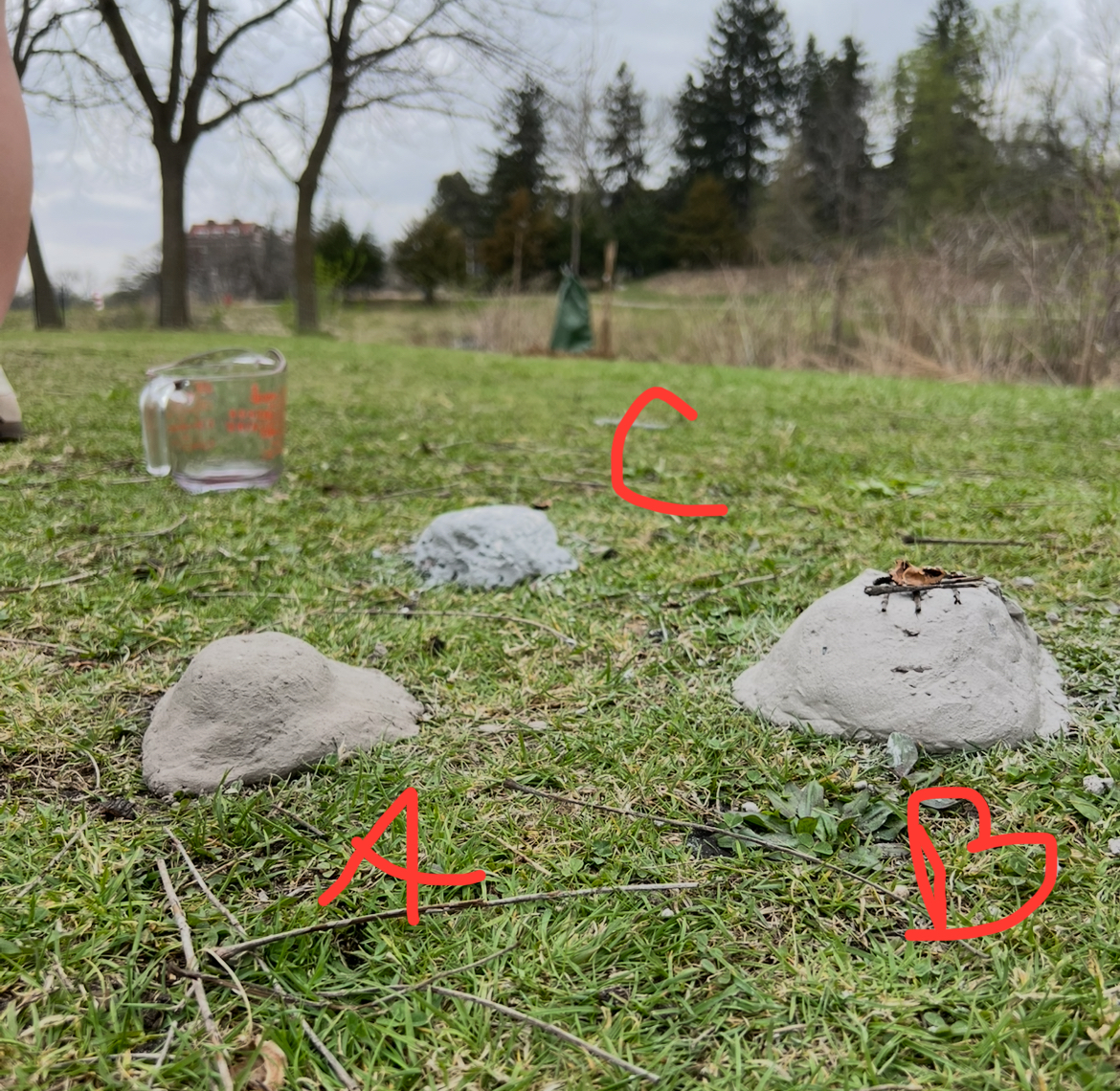


Multiple groups commented on the little amount of water required to greatly increase the liquidity of the mixture, leading them to use wine instead for greater precision. Some groups also mentioned the importance of using bone ash to make the altar stick together.
RESULTS
Part 2 of this lab was a bit more unique because each lab group got to mix and match each of their lab materials (see Fig. 6). Most groups were able to find some combination of materials that was “cement” enough to create a small ash altar. The true test of this experiment is when our class heads back to Mai-Fete Island in a couple of weeks to see which ash altars are still standing, meaning that they have withstood the true test of the natural environment that surrounds them.
Most groups found that if the ratio of ash:liquid was off and too much liquid was used, regardless if it was wine or water, the ash altar would be too aqueous and would not form well. Bone ash was found to be one of the strongest and most firm ingredients for the ash altars, placing it above the other possible types of ash like fireplace ash and fire pit ash. Additionally, water seemed to be the more “cementing” ingredient, placing it over the alternative liquid which was box wine.
The drier and firmer the mixtures were, the easier it was to shape for the groups, especially since everyone was aiming to recreate the Olympian ash altar which is thought to have been shaped somewhat like a pyramid with a flat top. There was a fine line between firm enough to hold its shape and not to dry or otherwise it would crumble.
Most groups were able to create a mixture that was strong enough to hold its shape and some even decorated their ash altars and placed mini ritual fires on top. It will be interesting to return to the island in a few weeks to see what ash altars are still standing.
CONCLUSIONS
PART 1: RITUAL
Given the variations between each group’s experiment, it is useful only to compare like aspects of different experiments.
Taking averages of total times (180-degree tail curl, femur break, cooked splanchna) across the groups, we see that the oxtails take about 31 minutes, the femurs 25 minutes, and the splanchnas 16 minutes. Considering Group 4’s 90-degree tail curl time of 10 minutes, an interesting correlation arises: if one were to place the femur and oxtail on the fire at the same time, and then begin roasting the splanchna when the tail achieved a 90-degree curl, the splanchna would finish cooking at almost the same time the femur breaks.
With the prevalence of splanchna roasting above a 90-degree tail curl in vase painting depictions of these rituals, it must be considered that these vase paintings are snapshots of a singular picture in a singular moment in time, as opposed to contractions of distinct events over the course of several hours. That is, roasting the splanchna over a curling tail actually occurred, as opposed to the two activities being separate, and simply depicted together.
Beyond the practicalities of a femur acting as a cooking timer, such a practice could point to the following religious belief: the fire is most religious (for lack of a better term) when the tail’s curl is between 90 degrees and collapse. In analogy, the god(s) pick up the phone when the tail reaches 90-degree curl, and hang up when it collapses. It follows that the best time to sacrifice the splanchna would be during the call.
The ritual process is highly predictable: the tail will curl, the femur will break. Given how often ritual sacrifices were performed, it is unlikely that their predictability was not exploited. In future experiments it would be worth testing the femur’s efficacy as a cooking timer in order to determine whether this method was one such exploitation.
PART 2: ASH ALTAR
It is difficult to draw meaningful conclusions concerning ash altars at this point in time, as it is unknown which mixtures will hold up best through weathering. Additionally, qualitative analysis and design intentions varied between groups, so a mixture that is “too aqueous” for one group’s desires may be too “crumbly” for another, or such descriptors may be referring to identical mixtures. That is to say, the following conclusions are highly speculative.
Preliminary results indicate that a higher ash content creates a stronger mixture at the expense of manipulability, and vice versa for a higher liquid content. It appears that mixtures featuring an ash:liquid ratio of about 3:1 are the strongest structurally while still manipulable (Fig. 6 altars 2.2, 4.3, 6.3), although exact ratios depend on ratio of water:wine (altar 2.2 has a 3.2:1 ash:liquid ratio and only contains water, while 4.3 has a 2.8:1 ratio and contains only wine). The effects of different types of ash are unclear. Altar 6.2 bucks this 3:1 trend entirely. Furthermore, results indicate that in mixtures which were too dry, those with more water than wine would “crack” (3.1, 3.3, 3.4), while those with more wine would “crumble” (2.3, 5.5).
Future experiments concerning ash altars would benefit from being more regulated, especially regarding the qualitative analysis. The introduction of quantitative analysis, such as viscosity measurements, would also be beneficial. Results from this experiment could serve as a guide for future experiments as to which ingredients and ratios are likely to work, and which are not.



0 thoughts on “WEEK 4 LAB SUMMARY: RITUAL”