

Noah Laitala, Bella Crum, Sasha Rapacz
In the beginning there was the Loom, and the Loom was with warp, and the Loom was warp. The same was with the tapestry and the cards. All things were made by yarn; and without yarn was not any thing made that was made.
(The Book of Archeology, 1:1-3).
Introduction
In this lab, we tried our hands at weaving fabric on a warp-weighted loom, a tapestry on the small tapestry loom, and yarn bands through the process of card weaving.
Some groups spend significant time detangling the yarn that was dyed last week at Get Bentz farm. Incorporating last week’s wool processing into our procedures for this lab gave us a more complete look into the textile production process. We saw our product go from sheep to yarn to loom.
Because some stations and activities required more time than expected, we had less time overall at each station that the lab had expected.
We found that, while the warp-weighted loom and the tapestry loom shared many skills, card weaving was the most different of the three and had its own set of skills and obstacles.
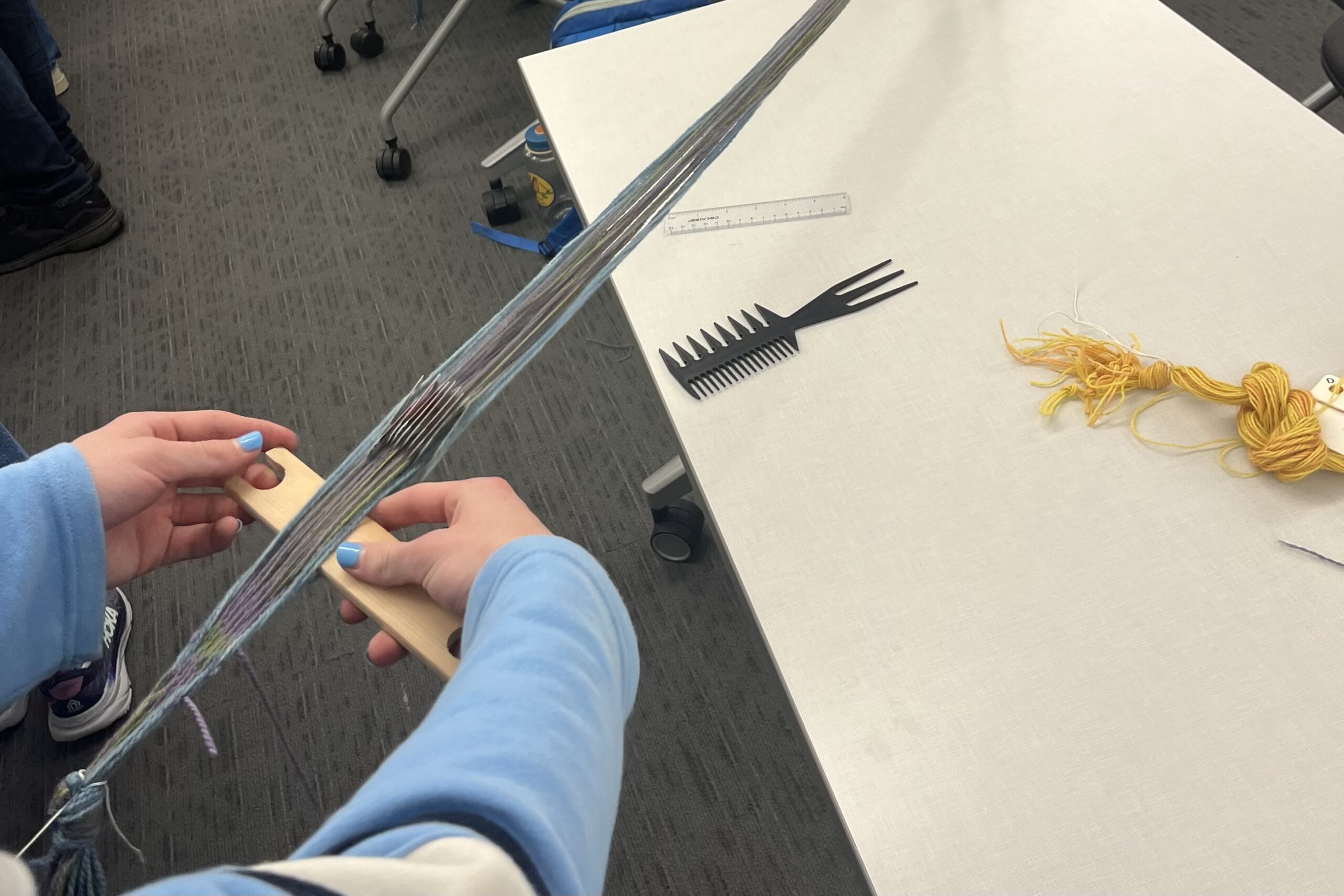
Tablet/ Card Weaving

Not everyone was able to spend a lot of time card weaving, and not every group was able to measure their bands the same way, so concrete data analysis of card weaving is difficult for this lab. However, a common theme I noticed was that most people who spent most of their time card weaving were able to produce bands that were 15-30 cm long by the time they were measured.
Two other common themes I noticed were how long it took to warp and the fact that people tended to get far more efficient with their weaving as time went on. Warping the cards seemed to be the hardest and most time consuming part of the process, with it taking on average thirty minutes to an hour just to set up the cards. However, once they were warped, students tended to find the weaving process itself to be rather quick. In fact, many groups reported that weaving went faster the later they were in the process, with one student from Group B going from about six and a half minutes per ten picks at the beginning of the lab to one minute and 48 seconds per ten picks by the end of the lab.
Some students also reported difficulties in maintaining their patterns, whether it was through losing track of how many times each card was turned or making mistakes that only became apparent a few rows later. It seems, then, that card weaving may have been a rather quick process for someone with experience doing it, but it has a somewhat steep learning curve.
Warp-Weighted Loom Weaving

With the loom already set up and the weaving started, groups focused on the tasks of passing the weft string through the shed, beating the weft, and changing the heddle bar’s position. In other words, this process entailed creating a new row by threading the loom, packing down the row tightly to create a strong textile, and changing which half of the threads would be in the front to create that alternating thread pattern. Students rotated with who would complete each task, and measured how many rows could be completed in a set time frame.
Groups reported lots of variation with how quickly they could create new rows. A common theme was that as rounds of weaving went on, efficiency increased. Groups C, E, and F all produced more length of woven threads as group members became more accustomed to the process.
| Job: Beating | Job: Passing Yarn | Job: Combing | Rows |
| Student A | Student B | Student C | 4 |
| Student B | Student C | Student A | 6 |
| Student C | Student A | Student B | 9 |
The large scale of this loom and its demand for multiple jobs translated well with how efficient it turned out to be in comparison with the card weaving technique and tapestry loom. Group A reports that the warp-weighted loom yielded 2.66 passes per minute while tapestry weaving yielded only 0.4 passes per minute. This makes sense, as although card weaving was probably the fastest with producing rows, it was only about two inches wide, and therefore produced little. For it to be reasonable for several people to devote time to the warp-weighted loom, it would need to produce a lot, which was consistent with our findings.
Tapestry Weaving

This method was much more versatile than the warp-weighted loom weaving. Similar to the card weaving technique, each row of the tapestry was customizable. The weaver could change the color of their threads or even create patterns in the weft by only bringing the shuttle halfway through the width of the frame.
Another possibility of control over the pattern involved brocade or embroidery. One student used a needle to poke through a tree design on top of the woven rows. By supplementing the bass design with additional threads, more complexity could easily be added over the top of an existing design. This might also allow for careful rationing of more valuable colors. Although brocade is able to be used in other weaving techniques as well, the greater surface area and consistent in a tapestry compared to tablet weaving once again allows for more control and deviations from repetitive patterns.
Because of the more structured tension of this loom, it seemed that the textile itself could be wider, perhaps because there was more resistance to the threads being pulled together with fixed tension rather than hanging weights. It is worth noting that there was a significant limit to the warp length, unlike the warp weighted loom but similar to tablet weaving.
There was a shed rod already inserted between the threads, which meant passing the shuttle through that shed was very quick and efficient. However, when going the other way, it was very time consuming to pick the shuttle between the layers of warp, and it was easy to accidentally miss a thread or go over or under too many at a time.
Because this loom allowed for multiple colors and multiple shuttles being used at the same time, more than one person could work on the tapestry at once, therefore making each layer take less time than if it were one person doing a single color.
Conclusion
Ultimately, despite expectations, weaving was not something that pairs well with split attention. While with dying the wool, for example, it was possible to multitask by both watching the dying process and spinning the wool, weaving demanded the complete attention of (sometimes multiple people’s) hands, eyes, and minds. Most counter-intuitive to our preconceived notions was how demanding card weaving turned out to be, even though it was our most individual process.
As such, when mistakes occurred, they required intensive fixes. For example, at the warp-weighted loom, when the person passing the weft under the warps misplaced just one thread, the untangling process took several minutes.
Because of how difficult and time consuming weaving ended up being, we found a new appreciation for the oft-mentioned story of Odysseus’ wife Penelope and her nightly weaving. Our very little progress during our own projects made it much more believable she was able to trick her suitors into believing her project was as time-consuming as she desired, especially because, as we’ve discussed in class, weaving was understood as the women’s world, and the suitors likely wouldn’t have had a deep enough understanding to know how long such a project would actually take.
The biggest benefit from using an experimental approach to this topic is that it allowed us to better understand the processes than with reading alone. Since the readings could be rather technical, many of the details tended to go ‘in one eye and out the other,’ so to speak, while actually being able to manipulate the yarn with our hands let us more directly understand how the yarn would behave under different circumstances and with different tools.


0 thoughts on “Week 5 Lab Summary: Weaving”