

Ugo Anyaegbunam, Violet Wright, Eva Mazzola
Introduction
This week, the class learned about ceramics in Anglo-Saxon England. Our readings for the week included explanation to chaîne opératoire or “Chain of Operations” in making Anglo-Saxon pinch pots, the shift from the pottery wheel to hand-made pottery once the Romans left England, and the importance of tempering and working the clay before creating a pot.
In the lab, we aimed to answer the following question, “how do different tempering materials affect the survival rate of bonfire fired pots?” We will be unable to answer this question in our summary, as we are not firing the pots until week 6. In addition to our research question for the lab, we had specific learning objectives that we hoped to gain from participating in the experiment. We worked hands on with the clay, hoping to better synthesize the theory of chaîne opératoire, which we were able to do by particularly hydrating, adding temper, wedging, fashioning and finishing our pots. Like many labs we will do this term, pottery is still a skill and career for many people across the globe. This lab gave us a greater appreciation for the time and effort that goes into pottery, both in the days of Anglo-Saxon England, and today.
Methods
Day 1
Most groups (A-E) worked with 500 grams of stoneware clay, 80 grams of sand, and varying proportions of gravel and chaff amounting to 20 grams, such that the total mass of the clay was 600 grams. One group (F) worked with 500 grams of clay taken from the Arb, without any other inclusions.
Tempering Materials by Group
| | Clay | Sand | Gravel | Chaff |
| Group A | 500g | 80g | 19g | 1g |
| Group B | 500g | 80g | 18g | 2g |
| Group C | 500g | 80g | 17g | 3g |
| Group D | 500g | 80g | 16g | 4g |
| Group E | 500g | 80g | 15g | 5g |
| Group F | 500g | 80g | 14g | 6g |
Clay Composition PBM (Percent by Mass)
| Clay | Sand | Gravel | Chaff | |
| Group A | 83.3% | 13.3% | 3.2% | .2% |
| Group B | 83.3% | 13.3% | 3% | .3% |
| Group C | 83.3% | 13.3% | 2.8% | .5% |
| Group D | 83.3% | 13.3% | 2.7% | .7% |
| Group E | 83.3% | 13.3% | 2.5% | .8% |
| Group F | 83.3% | 13.3% | 2.3% | 1% |
Each person measured out the proportions of ingredients to add to the clay according to their group, and kneaded the tempers into the clay until they were mixed. Water was added as necessary to make sure the consistency of the clay was workable; ideally, when rolled into a snake, the clay should not crack.

Group F began by weighing out 500 grams of dry Arb clay and crushing it to a fine powder using bricks. To form a usable clay, water was mixed with the clay in the style of pasta dough, until the clay was a workable texture.

To avoid the finished pots exploding when fired, the clay was wedged. This process included kneading the clay to ensure there were no air bubbles, and also required the addition of water to keep the clay workable and avoid drying it out.
After the clay was prepared, test bars were formed. Each group formed an equal proportion of their group members’ clay into a 100 gram test bar. The group’s combined clay was formed into a test bar 15 cm long by 5 cm wide. A scale bar of 10 cm was incised in each bar, and each bar was labeled with the group’s letter.

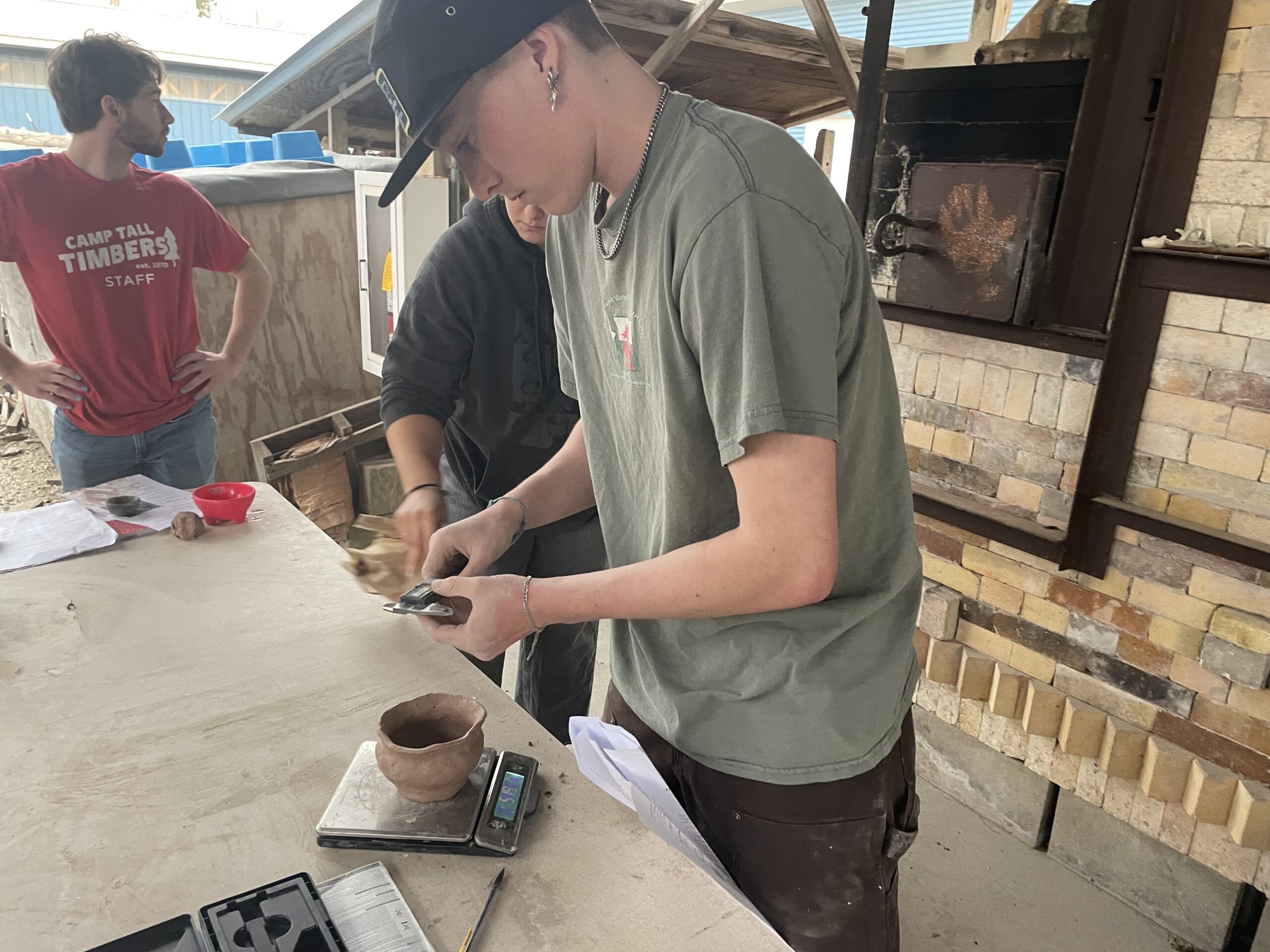
The pots were formed by rolling approximately ⅓ of the clay into a ball, digging a thumb into the middle of the ball, and pinching the sides to form a pinch pot. The remaining clay was used to form thick coils which were attached to the inside of the pot and then drawn up to form the sides of the pot. After the pots were formed, they were measured and set aside to dry.
Day 2
The next day, the pots had dried, and they were remeasured for an initial indication of water loss. The pots were then finished by smoothing with a wet hand, and then burnished by rubbing the sides with the back of a spoon. This was meant to ensure that the pots were as watertight as possible by pressing down the inclusions, although it was made more difficult by the gravel in the clay. The pots were decorated by scratching the sides with geometric patterns.
Future Days
The water loss of the pots will be remeasured one week after they were formed, and before and after they are fired, three weeks after they were formed.
Data
For our data summary, we chose to include data from the group with the most chaff (group A), the least chaff (group E), and the group that used Arb clay (group F). Additionally, we chose to use the test bars as the basis of our analysis, as it is the least likely item to have measurements distorted by human error. We believe this to be true because the test bar was designed initially to be a certain size and shape, in order to be straightforward to measure. For the pots, it is likely people measured in different places around their pot, making their data possibly unreliable.
Lab Group A
| Measurement | Original | After 1 Day | Amount Loss | Percent Loss |
|---|---|---|---|---|
| Mass (grams) | 100 | 85 | 15 | 15% |
| Height (cm) | 0.5 | 0.4 | 0.1* | 20%* |
| Length (cm) | 17.5 | 16.9 | 0.6* | 3.4%* |
| Width (cm) | 4.5 | 4.3 | 0.2* | 4.4%* |
| Scale Bar Length (cm) | 10.0 | 9.6 | 0.4 | 4.0% |
Lab Group E
| Measurement | Original | After 1 Day | Amount Loss | Percent Loss |
|---|---|---|---|---|
| Mass (grams) | 101 | 85 | 6 | 6% |
| Height (cm) | 0.5 | 0.3 | 0.2* | 40%* |
| Length (cm) | 19 | 18.5 | 0.5* | 3%* |
| Width (cm) | 5 | 5 | 0* | 0%* |
| Scale Bar Length (cm) | 10 | 9.5 | 0.5 | 5% |
Some material likely lost to shaving and carving designs
*Unintentional extra length likely from manipulation to achieve desired width
**Likely caused by measuring in different locations
There was not a significant difference between group A and E in terms of mass lost and shrinkage in size. From this data, we can make a conclusion that the amount of chaff does not affect the mass loss and shrinkage. For the individual pots in each group, group A’s mass loss ranged from 24 to 43 grams, and group E’s mass loss ranged from 34 to 40. The differences in mass loss could be due to the amount of water each person added to their clay.
Lab Group F
| Measurement | Original | After 1 Day | Amount Loss | Percent Loss |
|---|---|---|---|---|
| Mass (grams) | 100 | 87 | 13 | 13% |
| Height (cm) | 0.76 | 0.82 | N/A | N/A |
| Length (cm) | 15 | 14.5 | 0.5 | 3% |
| Width (cm) | 5 | 4.5 | 0.5 | 10% |
| Scale Bar Length (cm) | 10 | 9.5 | 0.5 | 5.% |
Group F used Arb clay and had a much larger range of mass loss in their individual pots, ranging from 2 to 36 grams. This wide range could possibly stem from the clay being naturally sourced, and each section of clay not having the same composition.
Conclusion
Despite the varied data on shrinkage and mass loss in the pots, as well as the pots having not been fired yet, we can make observations and conclusions about our experiment. As mentioned above, it is likely that human error led to the inconsistencies in the data. In future experiments done in class, it may be useful to make marks on where the pot was measured for height, diameter and width. One definite conclusion that can be made from this experiment so far is that there is definite shrinkage in the mass and size of the ceramic before firing. Overall, one of the most important pieces of this lab was to gain hands-on experience with ceramics in an attempt to better understand how Anglo-Saxon Englishmen lived their daily lives.




0 thoughts on “Week 3 Lab Summary: Pottery”