By: Ezra Kucur, Daniel O’Connor, and Ian Rock-Jones Introduction Experimental archaeology has been instrumental in deepening our understanding of Paleolithic food-ways and technologies, for example; fire control for cooking. While hearth-remains provide material evidence of fire use, experimental methods allow researchers to recreate fire-starting techniques, cooking practices, and heat management using only the materials available…
Starting amount of milk: 3,905g (3.78L) Milk Time Temperature (Celsius) Notes 0:00 5 Just started, placed on the fire 0:05 17 0:08 25 0:09 31 0:10 32 Removed from the fire 0:15 32 0:20 32 0:23 32 0:25 32 0:30 30 Moved closer to fire in attempt to come back to 32 0:35 32 Moved…
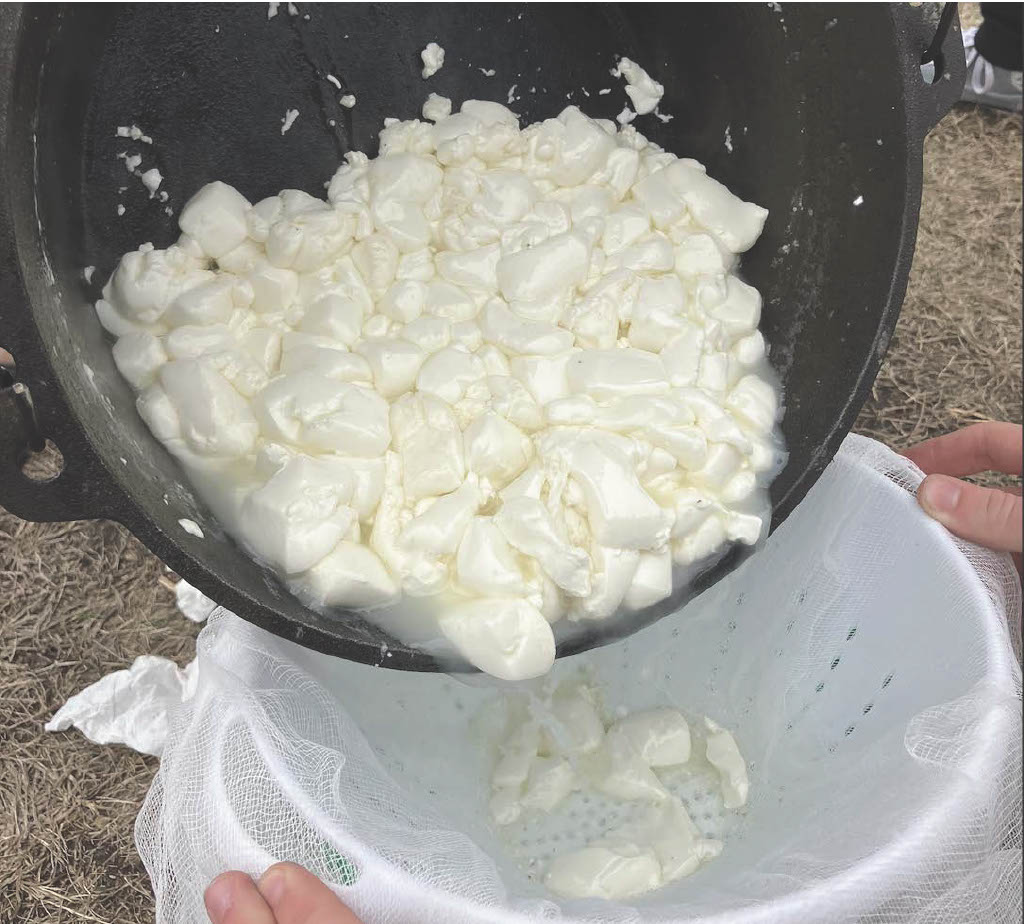
Cheese-making week entailed the very smokey process of heating milk combined with lemon juice and eventually rennet over a fire, letting the curds and whey naturally separate, cutting and straining the curds, and finally forming them into mozzarella balls in a salt bath. To maintain the proper temperature for cheese formation, which is about the…
Weights: Weight/volume of milk: 1026 g/L (total), Weight/volume of lemon juice: 226.6/0.22 = 1030 g/L, Weight/volume of curds: 668/0.61 = 1095 g/L, Weight/volume of whey: 2626/2.55 = 1030 g/L (total) Temperature of milk: Time Temperature Notes 0:00 12 C N/A 0:05 42 C N/A 0:15 70 C Remained consistently at 70 for a long time…