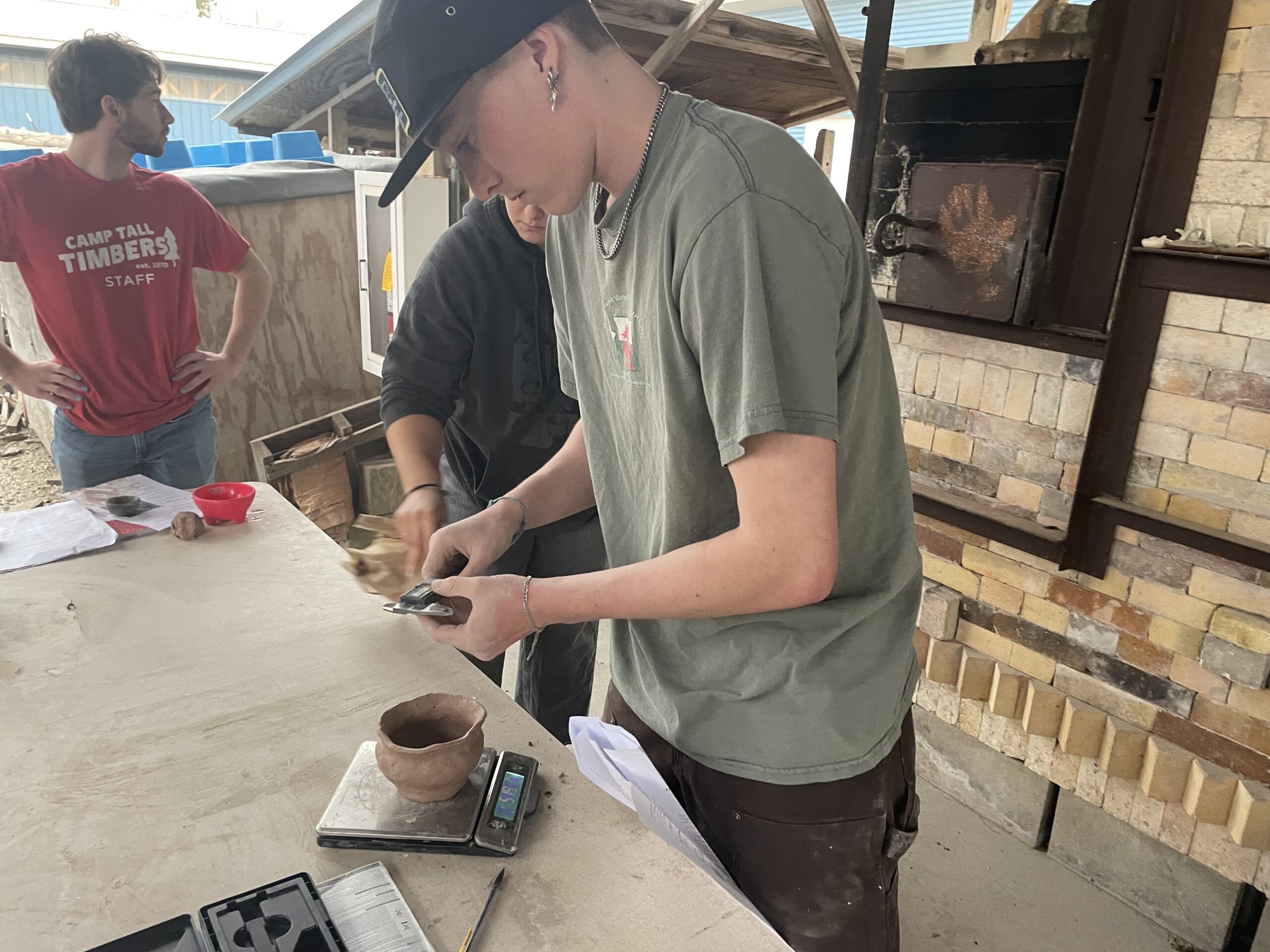
Ugo Anyaegbunam, Violet Wright, Eva Mazzola Introduction This week, the class learned about ceramics in Anglo-Saxon England. Our readings for the week included explanation to chaîne opératoire or “Chain of Operations” in making Anglo-Saxon pinch pots, the shift from the pottery wheel to hand-made pottery once the Romans left England, and the importance of tempering…
Composition table: The first table below is a depiction of the ingredients that each individual group member used in their clay. The second table is a calculation of, by percentage of ingredients in the first table, what the predicted composition of the clay is after tempering and wedging, using clay weight as an indicator. In…
Composition Each member of our group worked with a 500-gram portion of clay tempered according to the proportions below. Material Weight (g) Percent weight (%) Clay 500 82.92 Sand 80 13.7 Gravel 16 2.7 Sawdust 4 0.68 TOTAL 600 100 Vessel measurements and losses Every group member took measurements of their pot once they finished…
Group F: Clay data: We used clay that had been collected from the arb. As such, we did not add any tempers as the clay already contained some small rocks, sand, and other natural tempers. Because of this, the percentage of clay by mass is not recorded. Since we mixed our own clay, we also…
Parker Johnson, Group C Composition Each member of our group worked with a 600-gram portion of clay tempered according to the proportions below. Material Weight (g) Percent weight (%) Clay 500 83.3 Sand 80 13.3 Gravel 17 2.8 Sawdust 3 0.5 TOTAL 600 100 Vessel measurements and losses Every group member took measurements of their…